A Blog of Personal Thoughts
September’s Smells and Colors
September 2026
Five or ten years ago, we smelled autumn in the air the beginning of August. Nighttime temperatures began to get cooler and fell into the low 40s. Today the nighttime lows are in the low 50s. Some of the cottonwood leaves have just begun to turn yellow. Instead of this being August, it is now September when smells and colors that begin to change.
Today is September 1 and my houseplants still sit on the deck. Usually, I’d be scrambling to bring them all inside and wash the pots and plates they sit on. Not the past several years. Now calendula, pansies, marigolds, lady’s mantle, hellebore, forget-me-nots, and many more flowers still bloom in our gardens. In June, some porcupines snuck under the gate into the Community Garden and ate our starts of cabbage, cauliflower, broccoli, kale, and Swiss chard. All we have are flowers and plenty of them.
We haven’t had our first autumn storm, the storm where you want to be on land and not out to sea. The storm that can tear loose boats from their moorings. Oh yes, it is raining, pouring in fact. We live in a 17,000-acre rain forest, the Tongass National Forest. We live in a wedge of it next to Glacier Bay National Park. Our house is surrounded by dying pine trees, spruce trees, and the newcomer hemlock trees. The spruce are well over 100 feet tall. I look towards their tops and see those branches swaying in a slight wind of perhaps 10 miles per hour. Why are the pine trees dying? It is the progression from being part of a glacial area where lichen come first after the ice retreats, then mosses, small alder, then pine. These pine trees die out naturally when the soil changes and the much taller spruce take over. I say soil but it’s only about four inches deep here. The roots of the spruce trees are shallow, forming an elbow, or knee, to the trunk of the tree. Naturally so strong, they are used in shipbuilding.
Here in Southeast Alaska, we stay green all winter because of these evergreen conifers. Last winter we had 19.1 feet of snow. This winter it’s supposed to be an El Niño winter, warmer temperatures and lots of rain. I hope so. Snow is my favorite weather, but last winter was a bit much. We have no sun on the house from Halloween to Valentine’s Day. What lightens us up in this Hanzel and Gretl dense forest is the white snow. If we have no snow this winter, it will be dark back here. Last winter was so punishing, I hope for no snow this winter. These days I tell friends in town to remind me I said that in the dim months of November, December, January, and February. Already I can feel myself correcting that to a few snowfalls as I love to watch the flakes fall. If we have no significant and standing snow, I will not allow myself to complain about the dark this winter.
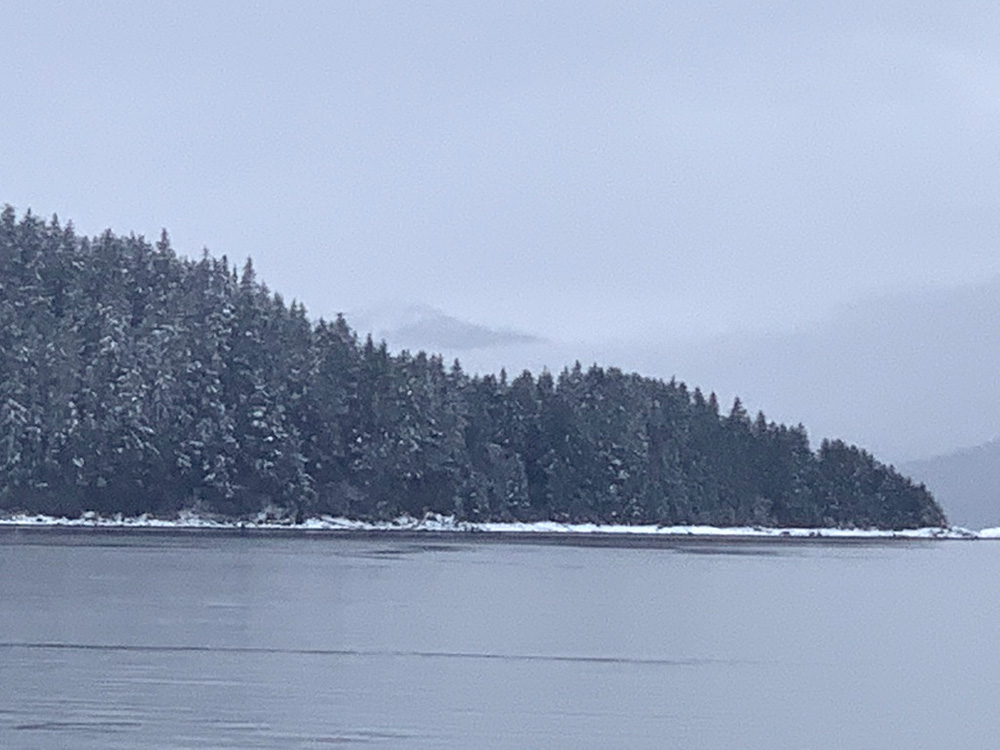 |
On the water 15 March 2022, 2:00 pm. In a normal winter |
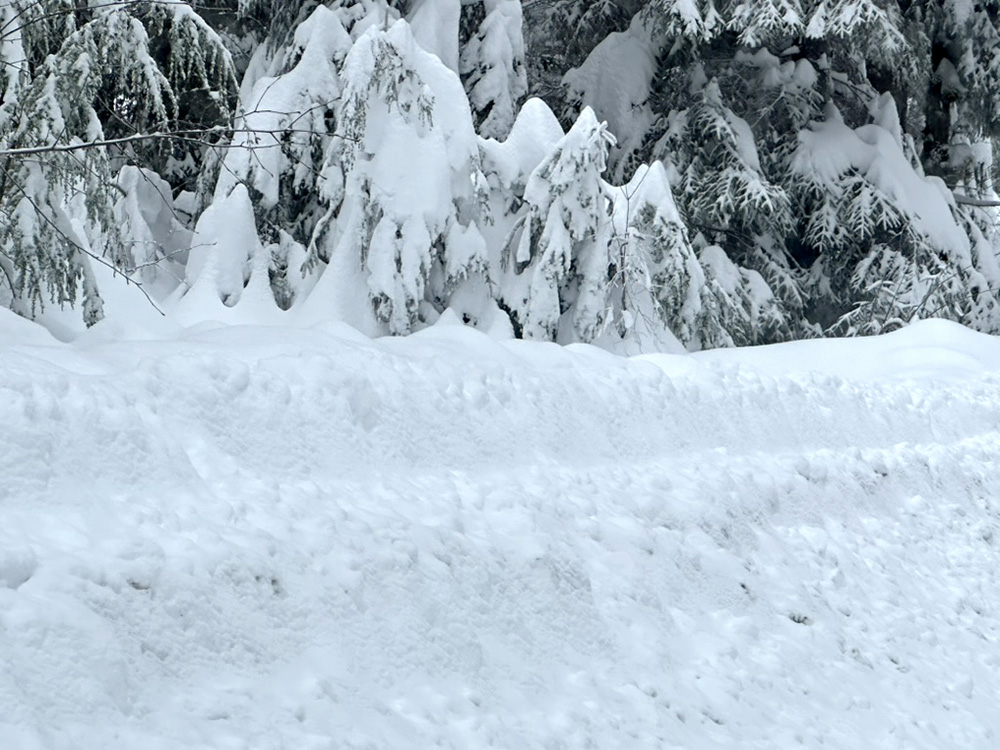 |
Snow in winter lightens things up, 29 December 2025. See the difference between the two photos? |
This was the entrance to our driveway on the day we arrived home from Juneau last winter, again 2:00 in the afternoon. How much lighter it is with snow.
As I write, I listen to the comforting sound of rain on my roof. If I grow tired of it, I’ll listen to music. If I grow tired of being indoors, I’ll put on my rain pants, X-Tra Tuff rainboots, and rain jacket and go for a walk. If I grow tired of the solitude, I’ll go in the house and talk to my husband or to the Fireweed Tea and Coffee Shop and chat with someone else who lives in town.

|